When we imagine medieval farriers, we often picture a blacksmith forging a bespoke horseshoe for a single horse. During times of war, the reality was rather different.
Keeping thousands of horses mobile was a major logistical challenge for medieval armies. A horse that lost a shoe could quickly become lame and unable to continue marching or to serve in combat and reconnaissance. Such problems even made their way into popular literature: in Chrétien de Troyes’ Perceval, the knight Gawain is forced to dismount his “hobbling steed” after it casts a shoe and begins to limp.
For a mounted knight, losing a shoe was not merely inconvenient – it could be catastrophic. Paid cavalry service depended upon having a fit and sound horse, and any reduction in a horse’s mobility while operating in enemy territory could place its rider at serious risk. A lame horse might prevent a knight from keeping pace with his comrades, escaping an ambush, or participating effectively in battle. In many respects, a medieval warhorse functioned as a knight’s personal military vehicle. Just as a modern soldier depends upon the reliability of an armoured vehicle, a knight depended upon the soundness of his horse. A lost horseshoe could therefore have potentially serious consequences.
English retinues therefore travelled with at least one person who was responsible for keeping the horses well shod. On the Scottish expedition in 1298 the king’s chief farrier was a man named Walter le Ferrator. Remarkably, he was still serving the Crown more than fifteen years later under Edward II, when records show him procuring horseshoes and nails for the campaigns of 1313–1314. Such longevity suggests that Walter was a highly skilled and trusted specialist in an occupation upon which the mobility of the royal army depended. Garrisons also employed standing teams of farriers: the one at Edinburgh in 1300 was headed by a man named Elias, and he and his assistants had 156 horses to attend to.
The scale of the challenge to keep warhorses shod becomes apparent when examining Edward I’s Scottish campaigns. Around 10,000 horses were mustered at Roxburgh in July 1298 in preparation for a campaign that lasted several months and covered approximately 300 miles. Keeping such a vast equine population shod required careful planning and organisation. Assuming hoof growth and shoe wear occurred at rates similar to modern horses, most would have required reshoeing at least once during the campaign. That meant thousands of horseshoes and tens of thousands of nails had to be made available wherever the army marched.
Royal administrators planned for this well in advance. Chancery records show enormous quantities of horseshoes being stockpiled and transported north. In 1300 alone, 3,000 horseshoes and 50,000 nails were sent to Carlisle for military use. In preparation for the Scottish campaign of 1319, another 3,000 horseshoes were ordered and packed into barrels for transport.
Perhaps the most surprising detail concerns the shoes themselves. One royal order instructed officials to provide equal quantities of large, medium, and small horseshoes. This suggests that medieval armies did not rely exclusively on individually forged shoes. Instead, they maintained stocks of prefabricated shoes in standard sizes that could be adapted to fit a range of horses. The existence of large, medium, and small shoes reminds us that medieval armies contained a wide variety of horses, from powerful warhorses and carthorses to smaller pack animals.
Importantly, this order also demonstrates that prefabricated horseshoes are not a modern invention. Medieval farriers worked in much the same way as many farriers today, carrying a selection of standard-sized shoes that could be modified to suit individual animals. On campaign, where speed mattered, a shoe that fitted reasonably well was preferable to spending valuable time forging one from scratch.
The evidence also hints that many shoes were reused. Medieval horseshoes were normally attached using six or eight nails, yet military records frequently list far more nails than would have been needed simply to attach sets of new shoes. Farriers may have been resetting loose shoes, replacing lost nails, or refitting shoes that still had useful life left in them.
These records reveal an often-overlooked aspect of medieval warfare. Historians have long studied the supply of food, weapons, and transport, but armies could not move without horses, and horses could not move effectively without shoes. Behind every mounted knight stood a network of farriers, blacksmiths, carts, nails, and thousands of prefabricated horseshoes keeping the army on the march.
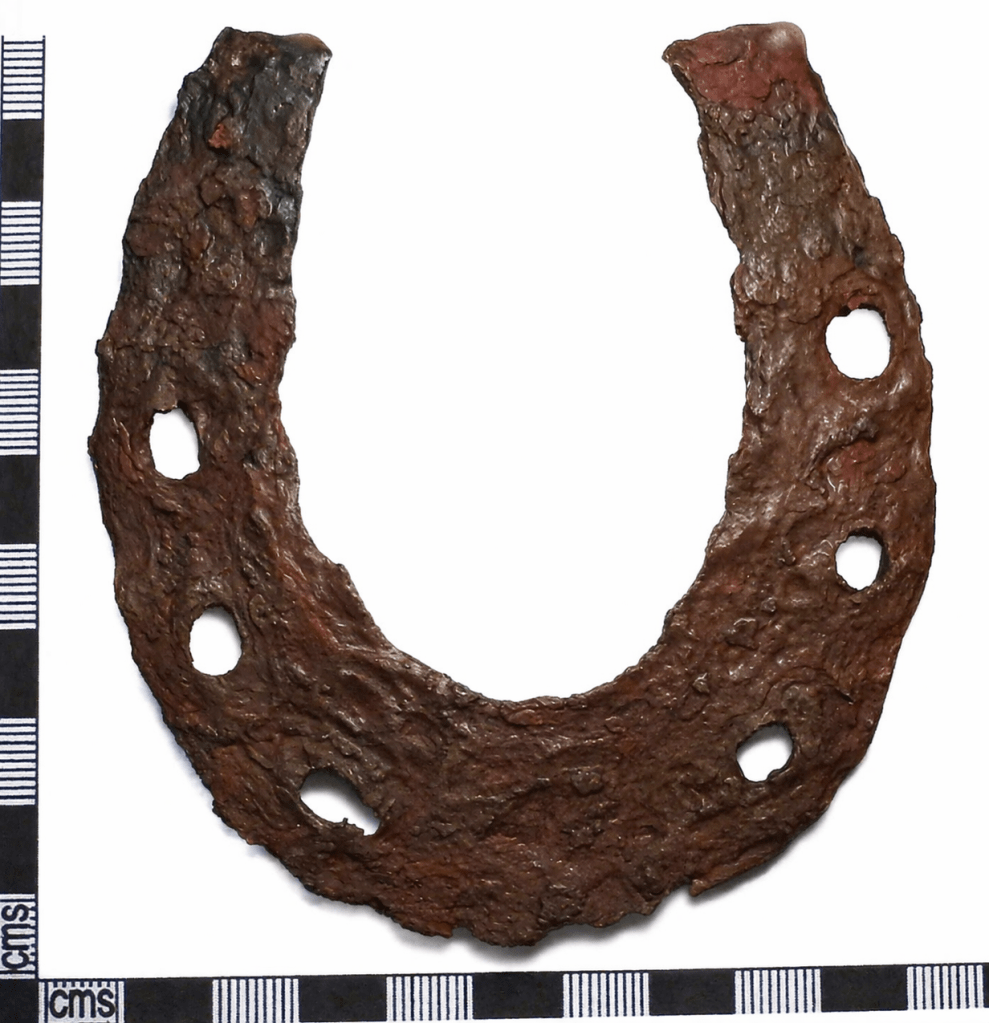
Below: a typical late thirteenth-century horseshoe of the kind used by horses in Edward I’s armies (Portable Antiquities Scheme, PUBLIC-D24EF7)
 Dr Emma Herbert-Davies
Leave a comment